

Body Positivity & Queer Love - An Interview with Author Paul Coccia
by Sage Nestler, MSW
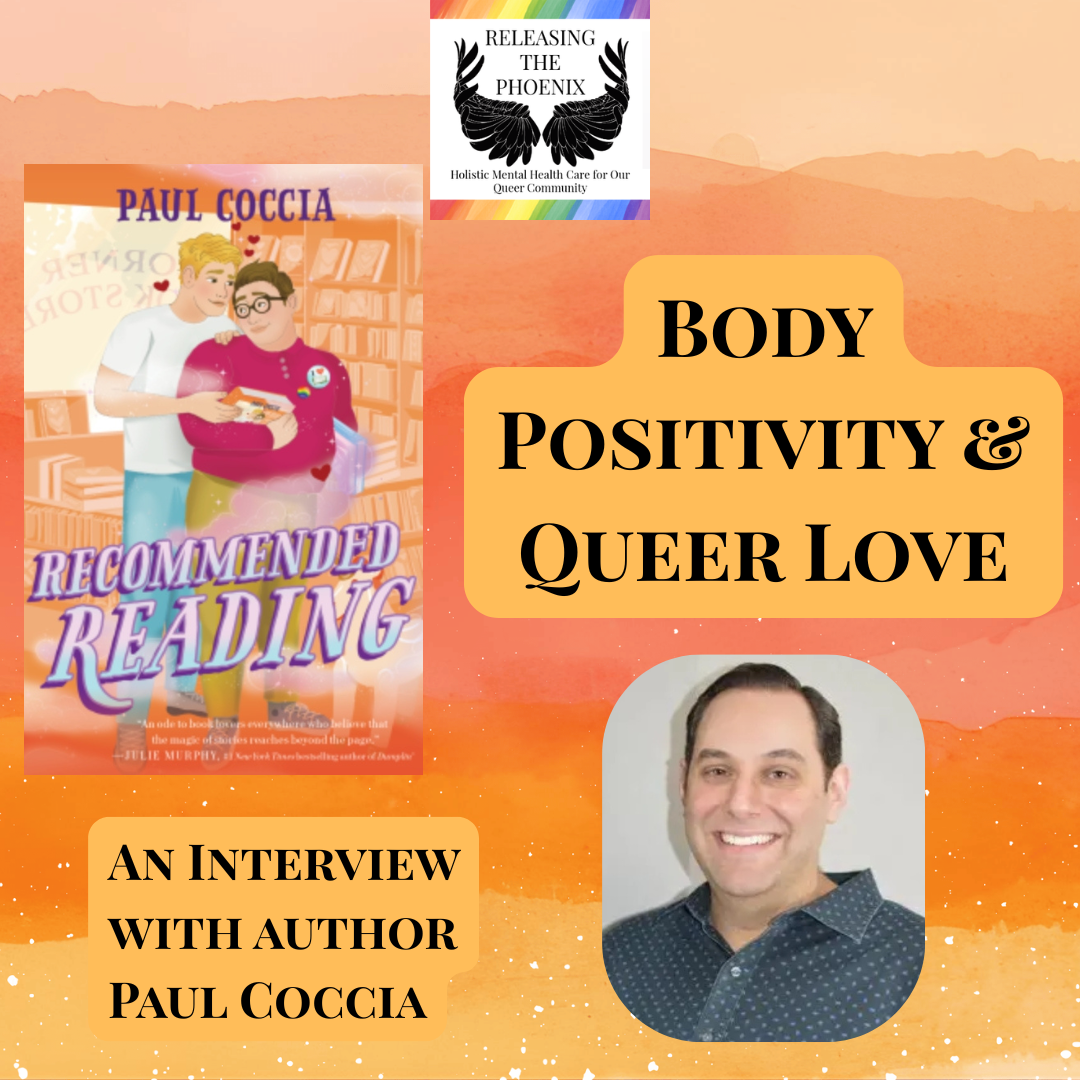
I first met Paul last year when I was on the tour for his book, Recommended Reading, and we quickly clicked! He is precious and brings such needed representation to the young adult genre - including body positivity and queer romance with characters who defy stereotypes. Recommended Reading spoke to me and is such a beautiful book for readers of all ages.
Find our insightful interview below, and I hope that Paul’s light brings you a sense of happiness.
Synopsis for “Recommended Reading”
In this opposites-attract YA rom-com inspired by Emma, a failed romantic gesture puts a damper on a queer teen bookseller’s summer of book matching and matchmaking until a handsome lifeguard and romance skeptic waltzes into his bookstore. Sometimes you get a second chance at happily ever after when you least expect it…
Curvaceous, clever, and an avid reader, seventeen-year-old Bobby Ashton never misses a main character moment. So when it comes to asking out his crush, he plans a romantic gesture grand enough to go down in local history. Unfortunately, though, his extensive knowledge of every rom-com trope ever doesn’t prepare him for how tragically he misreads the situation. Suddenly Bobby’s very public romantic gesture turns into an ordeal so embarrassing it could be a villain origin story.
Having masterfully shattered every plan for his perfect summer before college, Bobby’s last resort is working at his uncle’s sleepy bookstore. Soon, Bobby is expertly recommending books for customers to perfectly cure what ails them. Attempting to rebound after a breakup? There’s a book for that. Trying to tame your crochety coworker? There’s a book for that too. Then a plot twist Bobby never saw coming walks through the door in the form of Luke, an unfairly attractive and staunchly anti-romantic lifeguard.
Bobby’s blossoming connection with Luke reminds him of some of his favorite tropes: grumpy-sunshine, quippy banter, and even forced proximity. But after his last romantic disaster, should Bobby use all the tricks in his arsenal to turn Luke’s head? Or is he misreading all the signs again? Do grand gestures really need to be so…grand?
Perfect for fans of Becky Albertalli, Kacen Callender, and Jason June, Recommended Reading is a big-hearted rom-com about discovering love beyond what’s in the books . . . but hey, the perfect recommendation can get you pretty far!
Interview
Paul, growing up as a plus-size, queer, book loving kid, your new novel “Recommended Reading” spoke to me. I didn’t have access to any books with queer characters, let alone plus size ones.Bobby is quite literally my doppleganger!What were some of your inspirations for creating Bobby’s character?
Samesies! A lot of who I am tends to bleed into my characters and give them life.
I often got asked with my first book, Cub, if I was the main character. With Recommended Reading, I keep getting that readers hear my voice when they read Bobby. Physically, we’re similar although I think Bobby rocks his curves better.
When I was trying to understand Bobby, he struck me as a lot of my favourite aspects of Jane Austen’s Emma Woodhouse, especially Clueless’ adaptation. He’s meddlesome but well-meaning, benevolent, socially aware yet lacking self-awareness at times, and he has pretty good self-esteem, so he holds a belief he knows better than those around him.
I also fell in love with Bobby’s big main character energy. He isn’t going to let how he looks or who he is stop him from achieving his goals. In fact, sometimes he’s a bit too determined.
There are not nearly enough queer YA books that feature plus-size characters (with the exception of our beloved Julie Murphy.) With the way your story reached my inner child, I am so excited for how it will touch, and is already touching, other readers. Why do you think body diversity is important in young adult books specifically?
That there isn’t a Julie Murphy Official Fan Club may only be because there would be fist fights to see who the ultimate super fan is. We are all super fans! Julie is absolutely phenomenal.
I consider myself fortunate and privileged that I get to take part in the conversation surrounding weight, body image, and body/fat positivity. I learn a lot from these conversations. It’s also important to note that body diversity isn’t just about weight but includes other elements such as race, culture, gender, or ability.
To get personal, I was a kid whose pediatrician convinced my parents to put me on a diet from the age of six. I don’t blame my parents by the way who were doing what they felt was best for my health, especially not my mom who, as a woman, was raised in a culture where she was constantly being told to lose weight and was held to unrealistic body image standards. I saw my grandma and nonna struggle too and there are really funny stories about my grandma and I going on fad diets together.
But what I absorbed from the medical system and other places (school, neighbors, strangers who made comments) was that my body was wrong and needed correction. And when I didn’t lose weight, I wasn’t working hard enough at or committing hard enough to the solution. There was also messaging around morality because to that pediatrician, I was lazy and should be ashamed I wasn’t able to lose weight and look like my siblings or other kids. By the time I hit puberty, I was seeing a dietician and nutritionist which wasn’t a bad experience but was demoralizing. No surprise, I still do a lot of unpacking and dismantling of the relationships I developed with my own body and food and still have hang ups. Writing a character like Bobby helps me write a narrative that I was never going to be allowed to live.
I hope readers are able to see that their bodies are not problems to be fixed. Weight loss isn’t necessarily THE or even A solution. Frankly, it may not be achievable or even desirable. It was not healthy. I was made to feel very alone and also separate from my own body, which created a cycle in a child where it became very easy to look at my body as something deserving of criticism and hate. I would never wish someone else to have to experience these things, and so writing for young adults who can reject a damaging narrative earlier than I did is optimistic resistance on my part.
It’s important we keep telling stories where the plot issue and resolution hinge entirely on issues of appearance or identity. Showing a fat character living a happy, healthy life should not be that revolutionary, and I hope one day soon it no longer is.
The way you presented queer and body joy, while also highlighting the difficulties that can simultaneously arise, especially in adolescence, was so raw and honest. What would you like readers to know who might be struggling with their body image?
It’s important to remember that as we age, our bodies will change. So, it’s important to love your body as it is today, not as it may be tomorrow or may never be. I’m all for having the body you want, but realistically, you’ve got the one you have right now and tomorrow may not come. A lot of time is wasted on self-hate that you could spend enjoying yourself and living your life.
People like me or Bobby (and there are a lot of us) need to know we are beautiful, we were made right, and we are deserving of love no matter what body we live in. And it is our bodies, and we should rock them.
I also think it’s important to note that as someone no longer a teen myself, I look back on photos and I look young and (to toot my own horn) hot! All I remember feeling like was an ugly blob. I wasted not just time but energy and didn’t do things because I believed I was huge and hideous. I was not any of those things. My perspective was so off, and it took time to gain a more honest perspective. I also was probably spending my time and energy doing more damage to myself than good.
Also, your body is a fact. It doesn’t require anybody’s explanations or opinions. It just is. And you can be happy in it. You can be happy, period. No explanations or opinions needed for that either.
I loved the way you made Bobby’s connection with books seem so intimate. As a bibliotherapist myself, I loved how he essentially was a blossoming bibliotherapist with his ability to choose books for people based on what they need in the moment. What are some books that have been healing for you?
Books that were healing to me were usually because the right book came to me at the right moment. Boy Meets Boy by David Levithan was one and it was a hard book for me at first because it was the first queer book I read where the protagonists weren’t dealing with homophobia as the main issue in a queer story AND it was happy! Crazy! I’d only ever read queer books that ended in heartbreak, misery, or death and where the entire plot hinged on identity.
Another book that came to me at just the right moment was Michelle Kadarusman’s The Theory of Hummingbirds. It’s a book as much about a girl born with a clubfoot and her aspirations for when she has her final surgery to heal it as it is about reassessing and re-establishing one’s dreams and what it’s like to be extraordinary.
With laughter being good medicine, no books make me laugh as hard as Susan Juby’s. I adore them all. Each novel is a gem but her most recent are a series of murder mysteries starring a former Buddhist monk turned butler turned detective (reluctantly, by necessity) named Helen Thorpe. No one but Susan could pull off this premise. Susan was also the one who told me to read Boy Meets Boy, so we love Susan.
What is something you would tell your younger self that you wish you had known at the time?
My semi-serious answer is to start a skincare routine immediately. It’s good advice. An SPF moisturizer and a good cleanser will keep your skin from a lot of damage.
I think I might be a bit of a Cass, Bobby’s mother, and encourage a younger me to make more mistakes and take more risks (within reason.)
Mistakes just mean you learn how to correct and/or move on. There is always an excuse not to do the thing, so just do the thing. I don’t want to be in an assisted living facility one day thinking about the things I wish I did and knowing the only thing that held me back was me. It’s easier to do them and if you fail, oh well, you didn’t fail because you didn’t try.
About Paul Coccia
Self-Proclaimed Author of Glitterature, Paul Coccia has a specialist in English Lit from the University of Toronto and a Masters of Fine Arts in Creative Writing from the University of British Columbia. He lives in Toronto and can often be found baking in his kitchen with his dogs and a little grey parrot.
Find him online: https://www.paulcoccia.com/
